
 Home
Home Sign in
 Bitcoin price
 Ethereum price
 Cardano price
 Chainlink price
 Solana price
 Uniswap price
 Avalanche price
 Wallet
 Fees
Fees Exchange
 Business
 Luno API
 Discover
 Help Centre
 Status
 Company
 Careers
 Press
Press


March Crypto Economic Calendar
 Team Luno
Aside from the sharp dip at the start of February, Bitcoin and other major cryptocurrencies have been trading in a tight range. Could March’s key economic events shift the tone?
Investors are watching the Fed’s interest rate decision, the Bank of Japan’s policy move, and President Trump’s first visit to Beijing in eight years, where tariffs are expected to feature at the top of the agenda. Here’s what to watch, and why it matters for crypto in the month ahead.
February recap
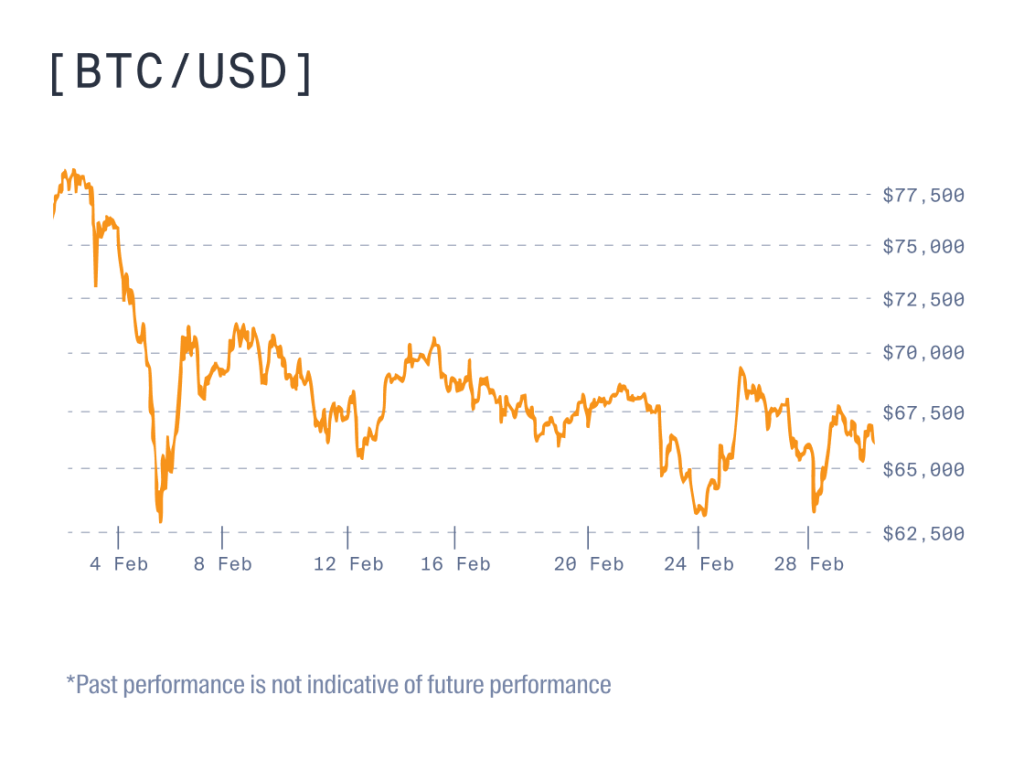
February began with another leg lower for Bitcoin and the broader crypto market, extending a period of uncertainty that, when viewed from a wider perspective, has persisted since October last year.
The market-cap leader fell from the upper end of $78,000 to lows of around $60,000 at the start of the month. There were several attempts at a breakout, but all proved unsuccessful. Apart from a few whipsaws, the price traded in a relatively tight range between $65,000 and $70,000 for most of the month.
Among the major developments during the period was the unwinding of the yen carry trade from late January into early February 2026, triggered by signals from the Bank of Japan of tighter monetary policy, including indications of rate hikes beyond 0.75%.
Ongoing uncertainty around the progress, or lack thereof, of the Crypto Market Structure Bill also weighed on sentiment, as disagreements between members of the banking sector and the crypto industry continued to delay the legislation. “While sentiment remains negative in crypto markets, we continue to believe that a potential approval of the market structure legislation most likely by mid-year could serve as a positive catalyst for crypto markets into the second half of the year,” JP Morgan analysts said in a report.
Markets were also assessing President Donald Trump’s leading candidate for the role of Federal Reserve Chair, Kevin Warsh, who is expected to take on the role around May this year.
What’s happening in March?
Polygon Lisovo upgrade
4 March
Why investors care
The upgrade is designed to speed up transactions between agents on the Polygon network, cover $1 million in gas fees, and improve wallet and smart contract support, all with the goal of increasing adoption, liquidity, and overall user activity on the network.
US unemployment rate
6 March
Why investors care
Unemployment fell to 4.3% in January, from 4.4% in December 2025, beating broad expectations of 4.4%. Nonfarm-payrolls added 130,000 jobs, the strongest in over a year as the labour market continues to stabilise, easing fears of an economic recession.
US inflation
11 March
Why investors care
Headline Consumer Price Index (CPI) numbers rose 2.4% year-over-year, below expectations of 2.5%, and the lowest since May 2025. “This is great news on inflation,” Heather Long, chief economist at Navy Federal Credit Union, told CNBC. How will the Fed factor this into the interest rate decision at the end of March?
Fed interest rate decision
18 March
Why investors care
More than 90% of futures traders expect the Federal Reserve to hold rates steady in March, according to the CME Group’s FedWatch Tool. In February, Fed Governor Christopher Waller said his support for a rate cut would depend on the strength of the 6 March labour market report, noting that a weaker reading would strengthen the case for him to vote in favour of easing. But Governor Waller is one of seven on the board of the Fed that decide the way forward.
Bank of Japan interest rate decision
19 March
Why investors care
Many analysts say February’s market volatility was partly driven by the Bank of Japan signalling potential interest rate hikes. Higher rates could reduce the profitability of yen-funded carry trades, where investors borrow yen cheaply to invest in higher-yielding assets abroad, potentially prompting shifts in capital flows.
Meanwhile, annual core inflation in Tokyo slowed in February, falling below the Bank of Japan’s 2% target for the first time in 16 months, according to data released late in February. Analysts remain divided on whether the softer inflation reading could alter the central bank’s rate-hike trajectory.
President Trump’s China visit
31 March – 2 April
Why investors care
President Donald Trump is set to visit China for the first time in eight years, the White House confirmed. The announcement came shortly after Trump’s tariffs, including some of those targeting China, were struck down by the Supreme Court of the United States.
Tariffs are expected to feature prominently on the agenda, with analysts watching closely for any shift in the strained trade relationship between the two countries, tensions that have previously sent ripples through global financial markets.
*Investing in cryptocurrency may result in the loss of capital. This information should not be construed as a solicitation to trade. All opinions, news, research, analysis, prices or other information is provided as general market commentary for information purposes only and is not investment advice or recommendation. Luno always advises you to obtain your own independent financial advice before investing or trading in cryptocurrency.
Did you find this useful?