
 Home
Home Sign in
 Bitcoin price
 Ethereum price
 Cardano price
 Chainlink price
 Solana price
 Uniswap price
 Avalanche price
 Wallet
 Fees
Fees Exchange
 Business
 Luno API
 Discover
 Help Centre
 Status
 Company
 Careers
 Press
Press


September Crypto Economic Calendar: dates to watch
 Team Luno
Crypto markets seemed poised for recovery at the end of July, but a major sell-off in early August dampened optimism. Markets remained choppy throughout the month, but rarely threatened to recover those early losses. Could September bring a shift? There’s speculation that the Fed might cut interest rates for the first time in years, what would a change in monetary policy bring for investors? Here’s a look back at August and what to watch out for in September.
What happened in August?
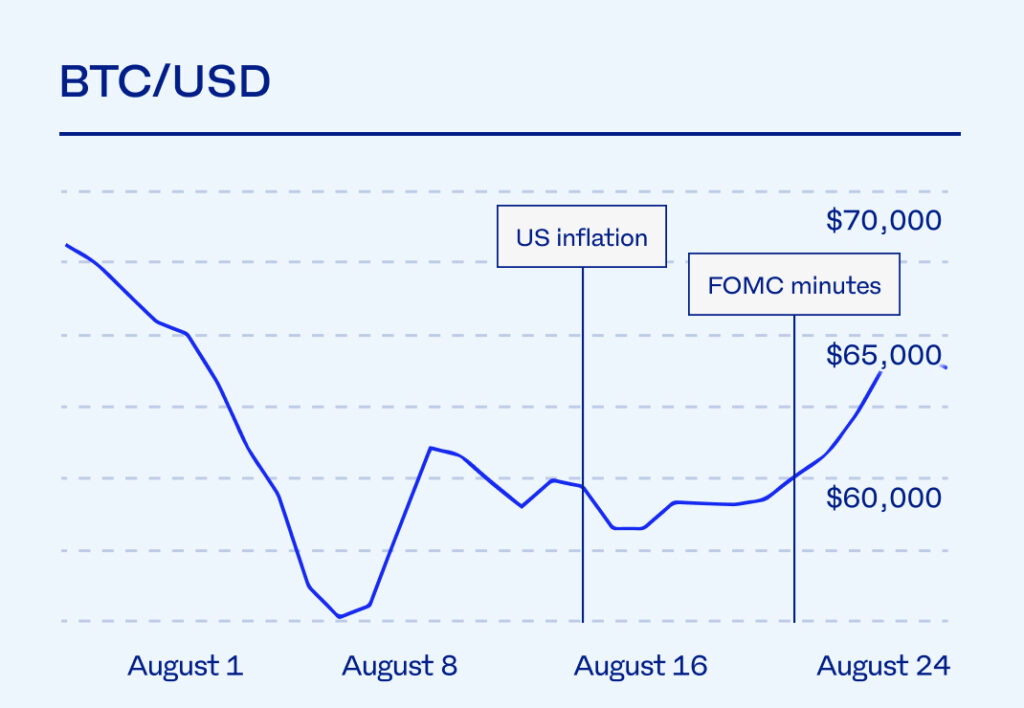
The month began with a sharp decline in the broader crypto markets, as the total market capitalisation of the asset class dropped from $2.4 trillion at the end of July to around $1.8 trillion in the first week of August. While there was a modest recovery in the second week, the markets have since remained in a fairly tight range. Bitcoin peeked above the $60,000 level several times in August, even briefly touching $62,000 on 9 August, but investors repeatedly rejected these higher prices. Ethereum mirrored this trading pattern.
A significant financial event in early August was the unwinding of the so-called Japanese yen carry trade on the back of raised interest rates in Japan. Investors ceased borrowing cheap yen to invest in other currencies, which analysts say led to a sell-off of those investments and a strengthening of the yen. Financial markets – including stocks and crypto – experienced notable declines following this event. Although there have been a few upward blips since, crypto markets have largely struggled to reclaim levels seen in late July. There was a notable pulse in crypto prices on 23 August, following Fed Chair Jerome Powell’s announcement that the time has come for the Fed to start cutting rates.
As we move forward, attention is shifting to the Federal Reserve’s 18 September meeting, where a rate cut is widely anticipated. The Chicago Mercantile Exchange’s FedWatch tool, a key barometer of market expectations, indicates that the majority of the market is predicting a 0.25% cut in the fed funds target rate. How will markets react to this key event?
What’s happening in September?
What? MATIC token migration
? When? 4 September
Why investors care: Polygon plans to migrate MATIC tokens to POL. POL will become the main native cryptocurrency of the network, replacing MATIC. The only change to investors will be a change in the name of the coin. The amount held in wallets will remain unchanged.
What? US unemployment rate
? When? 6 September
Why investors care: The US unemployment rate is a key indicator of economic health, influencing consumer spending, corporate profits, and monetary policy decisions.
What happened last month? US unemployment rose 4.3% in July and hiring slowed, signs of a broader downturn in the US economy.
What? US inflation numbers
? When? 11 September
Why investors care: Inflation numbers show us how our money’s value is changing over time. When these numbers shift, it’s not just about prices – it affects how people and businesses plan for the future.
What happened last month? US annual inflation dipped below 3% in July for the first time since 2021, fueling expectations of a Fed rate cut in September.
What? Federal Reserve Bank interest rate decision
? When? 18 September
Why investors care: A rate cut makes it cheaper to borrow money, boosting consumer spending, and can drive up asset prices, making stocks and other investments more attractive.
What happened in the last meeting? The Fed held interest rates steady between 5.25% and 5.50% in its July meeting.
What: Launch of Uniswap 4.0
? When? Sometime in September
Why investors care: Uniswap v4 is the latest version of the decentralised exchange protocol that introduces improvements to its liquidity pools, among other changes.
*This information is not intended to be nor does it constitute financial, tax, legal, investment or other advice; nor is it a call to trade. The information is intended as general market commentary for information purposes only. Before making any decision or taking any action regarding your finances, you should consult a qualified Financial Advisor.
Did you find this useful?